
A watershed moment reveals the ‘real’ Bali

Danielle Woolage
06 February 2026, 7:00 AM
Recently I was lucky enough to travel to Bali with a group of like-minded friends as part of a “spiritual rejuvenation” holiday.
We had all marked a mid-life milestone birthday and decided it was time for our own Eat, Pray, Love moment of self care. So we left our teenage kids at home and headed to the hills for a traditional Balinese purification ritual.
While we happily traversed the streets of Kuta to cries of “g’day mate, how’re ya goin” from cheerful Balinese shop owners, our real purpose was connection - not only with each other, but our spiritual selves.
And we found it, deep in the mountains of Ubud, during a traditional Hindu cultural ceremony called Melakut.
Don’t get me wrong, we still enjoyed Bintangs on the beach and laughed at the crude stickers and wood carvings targeting the widely loved but gently mocked Aussie Bogan traveller.
It was, however, a trip to Taman Beji Griya temple for the cleansing Balinese water ritual that was at the heart of our holiday.
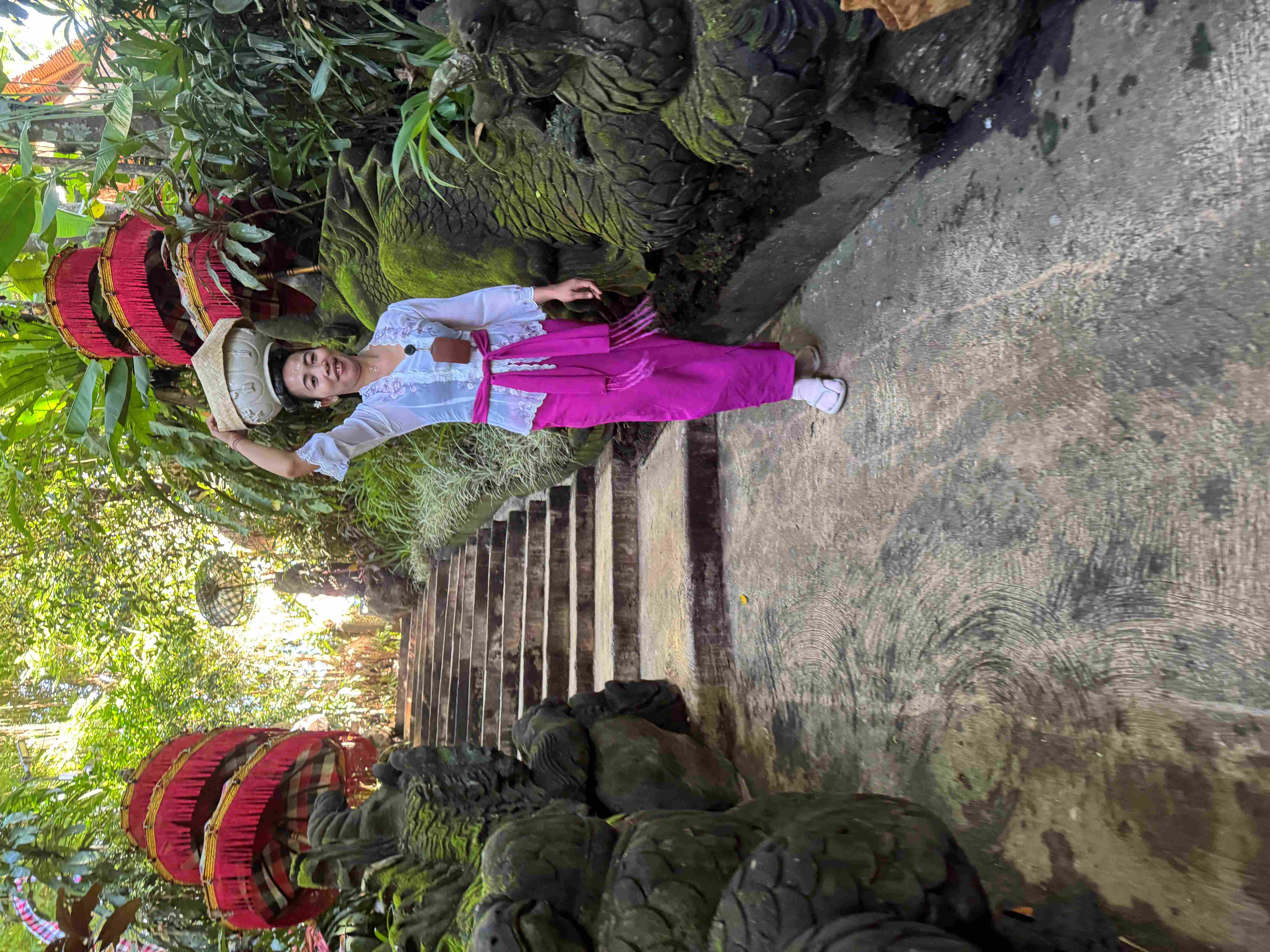
The temple sits deep in the lush, green mountains of Ubud, surrounded by waterfalls believed to flow with holy water designed to purify and cleanse those who come to worship.
The Balinese take part in the traditional Melukat cleansing ritual during a full or new moon, when the water is at its purest and has the power to wash away negative energy.
Our ceremony is scheduled a few days after the full moon and we wake at dawn, filled with negative energy from the wine-soaked night before, to beat the busy morning traffic.
As we weave our way up the mountain, through tiered rice paddies and small villages, the slower-paced countryside is a welcome reprieve from the hustle and bustle of Kuta’s busy streets.
When we arrive at Taman Beji Griya temple we have the place to ourselves for a private ceremony. It is well worth the extra cost as the temple quickly fills with visitors by mid-morning.
Taman Beji Griya has been used by local families for religious ceremonies for generations but was only opened to the public in 2017, allowing westerners to take part in purification ceremonies for the first time. Hundreds of visitors now cross the temple threshold each week and the best time to visit is early morning on a weekday.
As we walk through the tropical forest to the entrance of Beji Griya we are greeted by our guide Karen Bayu Aditya Putra.
Bayu is a photographer and artist - he designed the logo for the uniform worn by the temple’s guides - and is renowned for the stunning images he captures of those visiting the spiritual site.
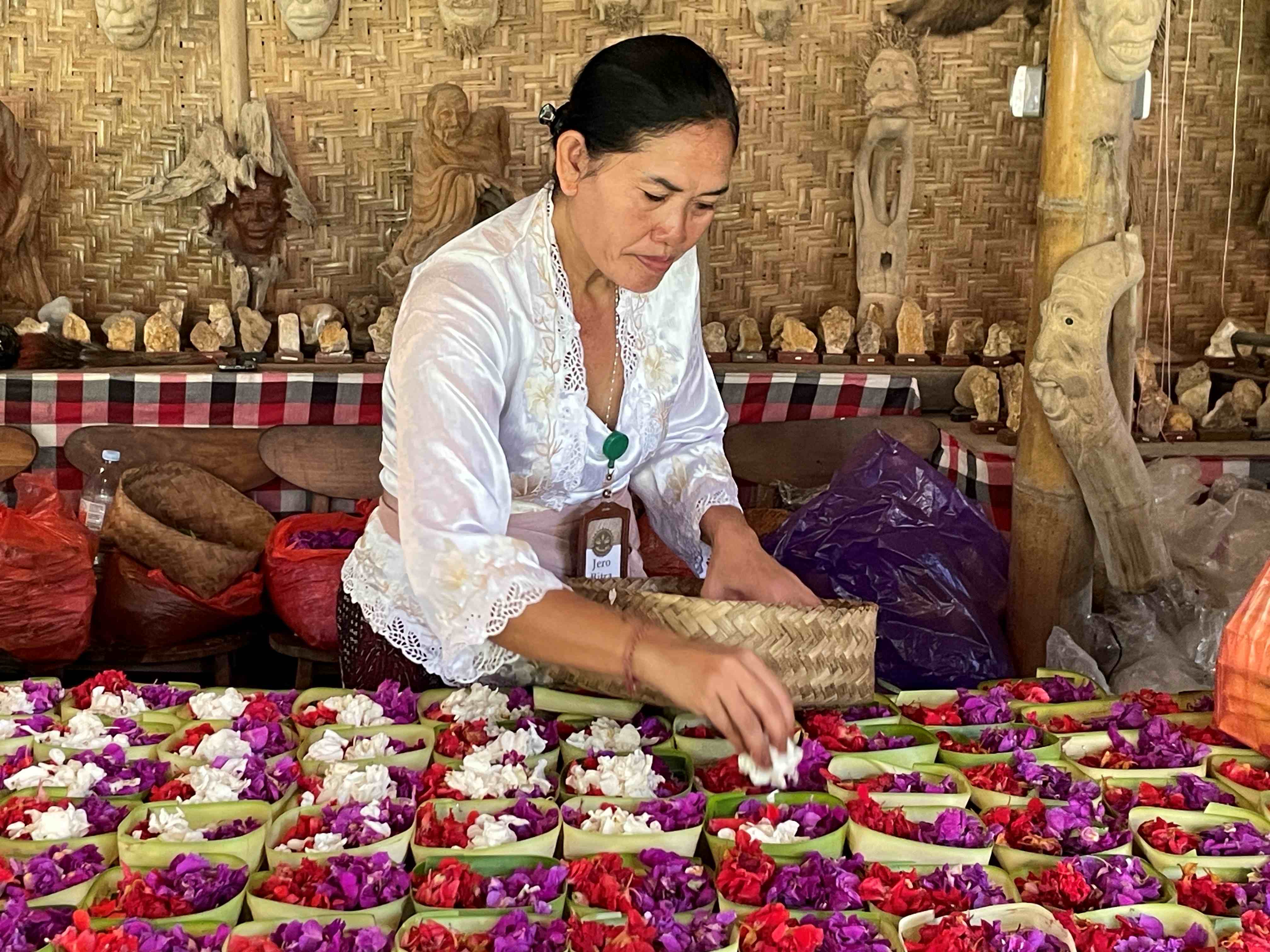
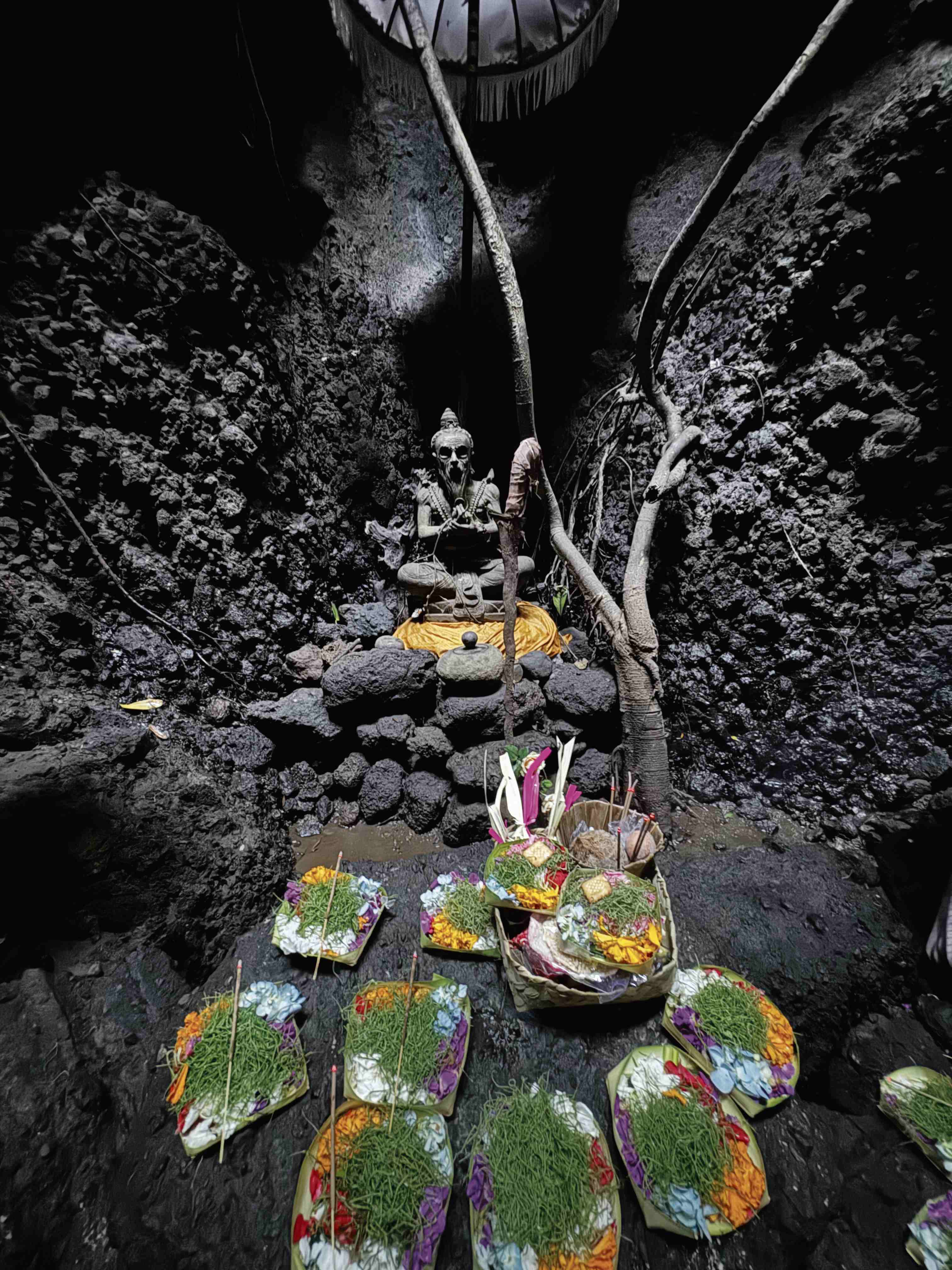
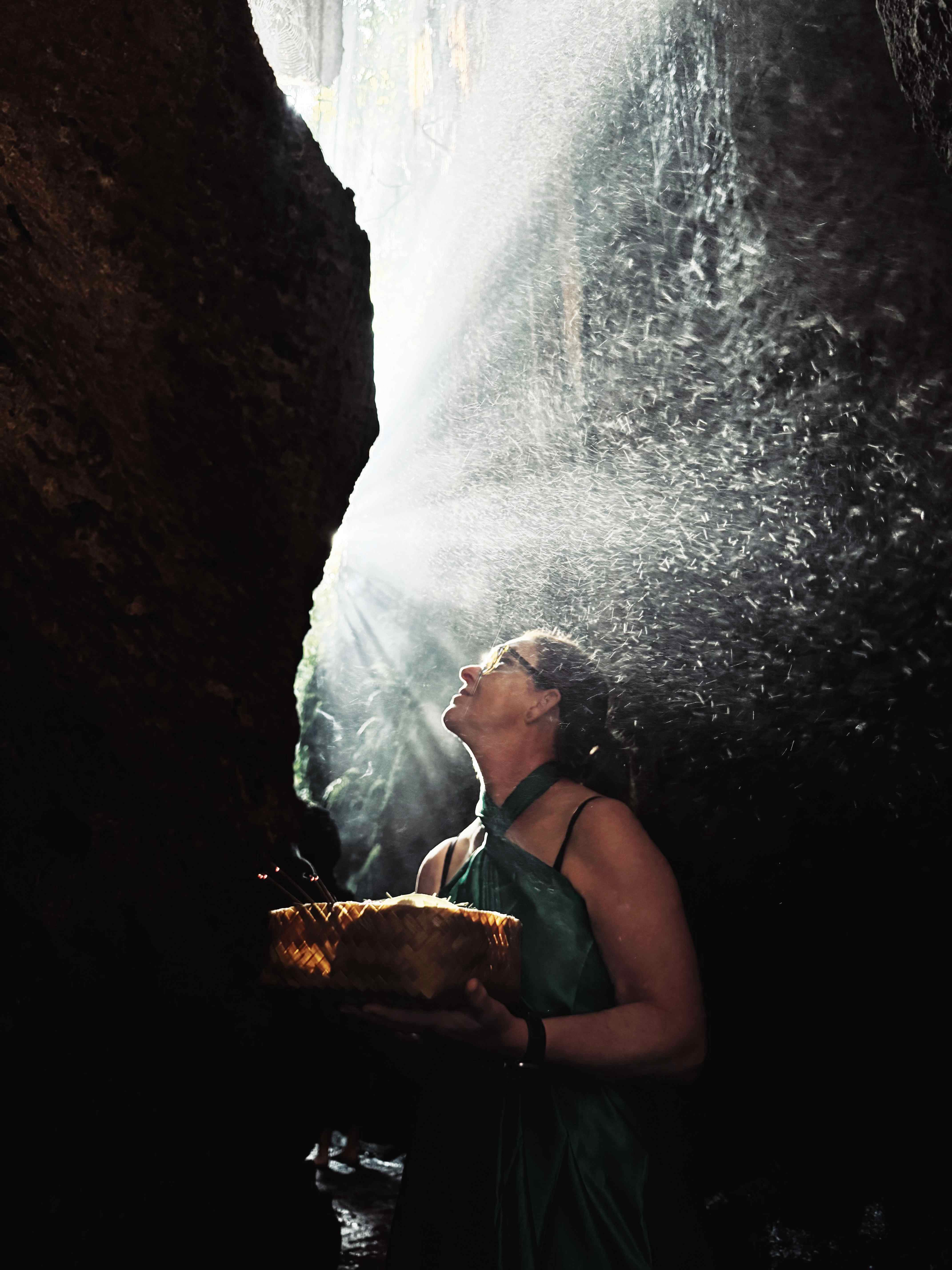
Bayu asks us to each choose a brightly coloured sarong, which we wear into the temple as we walk though waterfalls, canyons and grottos offering gifts, known as Canang Sari, to the gods.
The intricate baskets, woven from palm leaves, are filled with flowers, incense and rice, and are a fundamental part of Balinese Hindu culture, representing gratitude, balance and devotion.
As we approach dozens of intricately carved stone gods Bayu instructs us to take a deep breath, close our eyes, give thanks for that which we are grateful, and place a Canang Sari in front of each deity.
We offer our thanks and feel our limbs begin to loosen and relax.
Bayu tells us to reach out and touch the ancient, gnarled banyan tree guarding the temple’s entrance. The Balinese believe banyan trees connect the physical world to the spiritual realm.
The tree - skirted in the black-and-white checked Balinese poleng cloth which represents the harmony between good and bad, light and dark - is a balance of opposites, rooted in the earth while its branches reach for the sky, its leaves smooth and limbs rough.
We touch the tree and ask for a blessing.
“Feel its energy, it is the home of our spirits and ancestors,” explains Bayu.
While the banyan tree is an important part of the purification ritual, the temple’s waterfall is the centrepiece.
As we stand underneath it, getting flogged by fast-flowing water, Bayu yells instructions over the noise: “Scream as loud as you can, let out all the bad energy”.
We do as we are told and it feels oddly liberating to shout louder than the crashing water.
We move to a slower flowing waterfall - a relaxation massage compared to the deep-tissue hammering of its neighbour - and Bayu tells us to “dance and give thanks for our blessings”.
We laugh and dance, careful not to slip as we celebrate, holding each other upright in our silliness.
Next a holy priest chants mantras to bless the water which he pours over our head - it signifies rebirth and cleansing.
Bayu explains Melukat will wash away stress and bad luck, help our body and mind feel calm, bring balance and inner peace and open our hearts to blessings.
“Now you will feel calm and new again,” says Bayu as he ties a band of tri-coloured string, known as tri datu, or three powers, around our wrist.
The red string signifies Brahma the god of fire and knowledge, black is Vishnu the god of water and giver of life and white is Shiva the god of destruction and cleansing.
“Don’t cut it,” instructs Bayu. According to local legend the band falls off when the wearer is spiritually cleansed.
We leave the ceremony feeling lighter, careful not to break our tri datu and grateful for the opportunity to experience the “real” Bali and its ancient traditions and culture.
NEWS