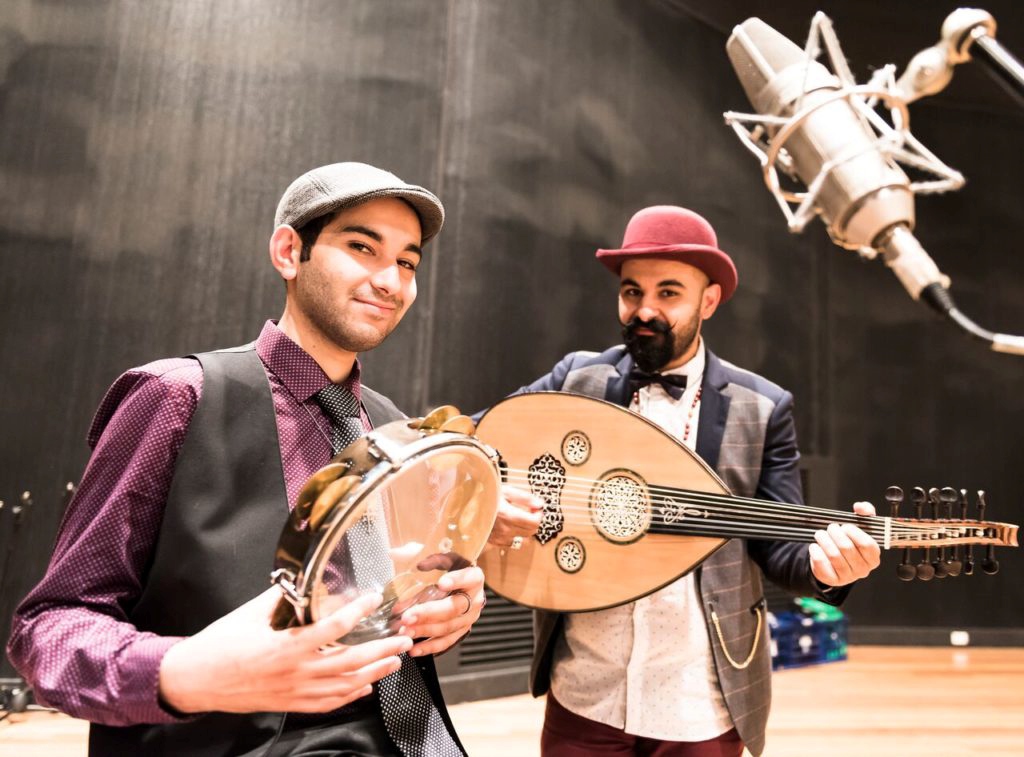
Wollongong Art Gallery is the city's hub for art, culture and community - a stunning building.It not only houses an impressive array of Aboriginal, colonial and contemporary artworks, but also provides a reasonably sized theatre space with exceptional acoustics where musicians can perform for us at their best.This was the case recently when the musician in question was Joseph Tawadros, classically trained musician and multiple ARIA winner, accompanied by his brother James, virtuoso percussionist.Occasionally in your life you will remember exactly where you were when you heard, or saw, or experienced, a meaningful event for the first time.I've been a fan of the Tawadros brothers since hearing, quite by chance, a recording of their collaboration with the Sydney Symphony Orchestra in 2019, broadcast by ABC Classic FM.In those days I lived on Berry Mountain, and a tree had come down in a paddock on our property. Hubby and I were clearing debris, and to keep us on the task, we were listening to the radio. The live concert started.I was immediately transfixed by this exotic Arabic music. The beat, the sensuality, the liveliness of it all was captivating.Happily, the ABC recorded this entire concert, and it won an ARIA for Best World Music Album the following year.Regrettably I had not seen the Tawadros brothers perform live, and so the opportunity arose last month. Wollongong happened to be part of their 2026 tour dates, performances stretching from Dungog, Adamstown, to playing with the Melbourne Symphony Orchestra at the Myer Music Bowl, then Ballarat, Tasmania, and back to Sydney.Seating wasn't allocated so best to arrive early I thought.Unfortunately, so did everyone else.Getting there half an hour before the start, we only managed the third row, and by 7pm, the room was packed, with lots of excited audience chatter and pre-show manoeuvring.At last, Joseph and James entered from the rear of the room, to welcoming applause.What immediately struck me was their sartorial splendour. Joseph is not a shrinking violet in his mode of dress, as indicated by his twirled moustache, black Fez with gold trim, gold scarf and glittering pink slip-on loafers. James was more sedate in collar and tie in muted tones while wearing a flat newsboy cap.They carried their Middle Eastern instruments as they entered, Joseph's oud, and James’ two percussion instruments, the riq and the larger bendir.The oud is an ancient lute-type instrument, pear shaped and fretless. Joseph's Egyptian oud of course had some customised mother of pearl bling and an in-built pickup for playing across genres such as jazz and classical.A riq is a traditional tambourine, while the larger bendir is a wooden frame drum. James is a virtuoso of both.They seat themselves on chairs on a raised platform under a circle of down lights, and the magic begins.The music is haunting, beautiful, and the audience is justifiably mesmerised.There are songs of healing, there are songs inspired by Middle Eastern poetry, songs of family, of work, of joy. Feverish pace, or calm, the effect on me is the same. Pure happiness.I am close enough to see the expressions on their faces as Joseph and James play - eyes closed, sheer immersion in their craft. Both men are masters of their instruments, and they love what they do. It shows on their faces.Interwoven between musical pieces is the "talking bit", the natural humour and wit of Joseph as raconteur, while his brother James sits expressionless, silent - the perfect straight man. Joseph talks about migrating to Australia from Egypt as a two-year-old, as well as life for him and his family in Australia and how much he loves Egypt. Then he also talks about his experiences in real life, and online, as a target for racist comments.Not funny at all. But he tells his story with humour and compassion. His message to us - to just be kind to one another - is delivered with such grace and good humour, we in the audience are all laughing. Life should not be so serious, he says.Too soon, the concert ends. It has been energising, and thoroughly enjoyable. We all leave with smiles.Thank you, Tawadros brothers, for sharing your skill, your mastery, your fabulous music, and your sense of fun.